Tesla is once again attracting global attention with its next-generation Roadster, a futuristic electric sports car featuring rocket-style thrusters and technology designed to push the limits of conventional automotive engineering. However, the vehicle represents more than an ambitious sports car project. It also highlights the growing competition between Western automakers and China’s rapidly expanding electric vehicle industry.
Unveiled in October 2026, the new Roadster demonstrates Tesla CEO Elon Musk’s ambition to combine automotive technology with aerospace engineering. While production is currently planned for 2028, several of the vehicle’s most extraordinary capabilities still need to be demonstrated in a production-ready car.
The bigger question is whether Tesla can turn its technological ambitions into a sustainable business advantage while the global automotive industry undergoes a major transformation.
What Makes the New Tesla Roadster Different?
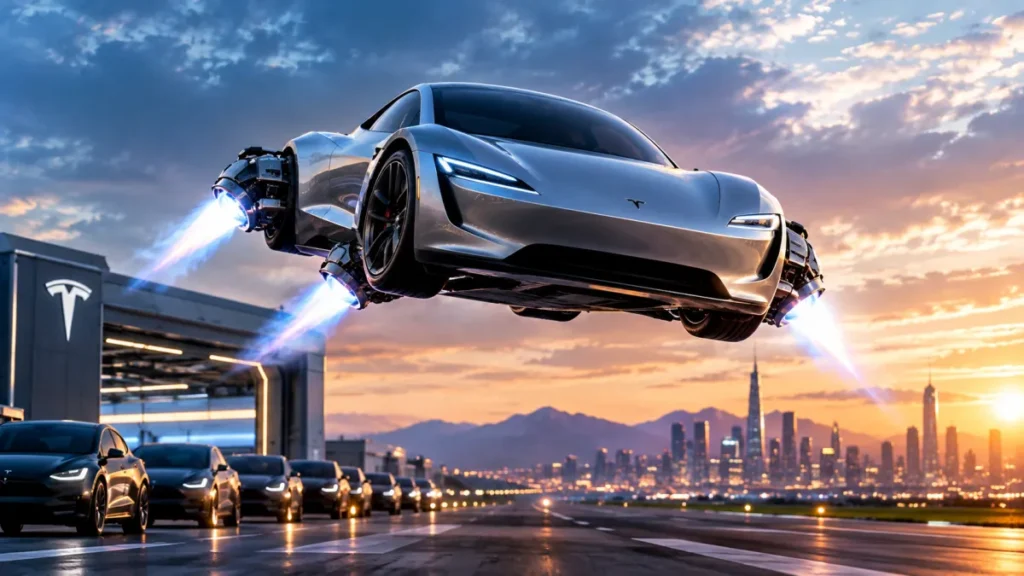
The next-generation Tesla Roadster stands out because of its unconventional design and ambitious performance targets. Unlike traditional electric sports cars, the vehicle has been presented with a system of cold-gas thrusters intended to produce short bursts of thrust.
During its October demonstration, the Roadster performed unusual maneuvers, including moving along an inverted ramp and launching over a line of vehicles. The presentation showed how Tesla and its aerospace partner, SpaceX, are exploring ways to bring technologies associated with rockets into automotive engineering.
Tesla has also promoted extremely ambitious acceleration and speed targets. However, advertised performance figures should not automatically be treated as independently verified results for a finished production vehicle.
The Roadster is therefore best understood as a technology showcase rather than proof that ordinary electric cars are about to start flying on public roads.
Production remains planned for 2028, and questions about final specifications, regulatory requirements, availability and practical everyday use remain important.
Why Tesla Is Moving Beyond Traditional Electric Cars
Tesla helped popularize electric vehicles by demonstrating that battery-powered cars could deliver strong acceleration, modern software and an appealing driving experience.
The company’s Model 3 and Model Y helped establish its position in the global EV market. However, the competitive landscape has changed significantly since Tesla first became a major force in electric mobility.
For readers interested in the latest electric vehicles, the “2027 Cadillac Escalade IQ” offers another look at how automakers are advancing luxury electric SUV technology.
Automakers around the world are now investing heavily in batteries, software, driver-assistance systems and connected vehicle technology. As more companies introduce electric cars, simply producing a battery-powered vehicle is becoming less distinctive.
Tesla is increasingly presenting itself as a company working across artificial intelligence, autonomous driving, robotics and energy technology.
The Roadster fits this broader strategy by creating excitement around engineering capabilities that extend beyond ordinary transportation. It can strengthen Tesla’s futuristic brand image even if the vehicle itself remains a relatively low-volume product.
Nevertheless, developing advanced technology is not the same as turning it into a profitable business. Tesla still needs to demonstrate that its broader ambitions can generate reliable products and sustainable revenue.
China’s Electric Vehicle Industry Is Becoming a Major Challenge
One of the most important issues behind Tesla’s strategy is the growing strength of Chinese electric vehicle manufacturers.
Companies such as BYD and other Chinese automakers have expanded their electric vehicle offerings across multiple price categories. Their competitive advantages can include manufacturing scale, battery supply chains, local supplier networks and the ability to introduce new models quickly.
These factors are putting pressure on established automotive brands, particularly in markets where buyers have numerous electric vehicle options.
China’s growing EV industry also reflects years of investment in battery manufacturing, vehicle electronics and domestic production capacity. As these capabilities develop, Chinese manufacturers can compete not only in their home market but also in Europe and other international markets.
For Tesla, this creates a difficult challenge. Its earlier success helped establish electric cars as desirable alternatives to conventional vehicles, but competitors have learned from that transition and are developing their own products.
A spectacular sports car may attract attention, but it cannot directly solve every challenge associated with manufacturing affordable electric vehicles at scale.
Tesla must continue to compete on price, technology, product quality, charging access and customer experience if it wants to defend its position in the mainstream EV market.
Could the Roadster Help Tesla Compete With Chinese Automakers?
The Roadster is unlikely to challenge high-volume Chinese electric cars directly because it targets a very different segment of the automotive market.
Instead, its value may come from brand positioning, engineering research and publicity. An unusual vehicle can attract global media coverage, generate discussion about future technologies and reinforce the perception that Tesla remains an innovative company.
This approach could help Tesla maintain a premium image while competition increases in the mass-market EV segment.
However, there is a significant difference between creating an impressive demonstration and producing a commercially successful vehicle. High-performance technologies can introduce additional costs, engineering complications and regulatory challenges.
The company must also balance investment in ambitious projects with the practical needs of customers who want dependable cars at competitive prices.
If Tesla can transfer useful innovations from experimental vehicles into its broader product range, the Roadster project could have benefits beyond its direct sales. If those innovations remain limited to an expensive specialty vehicle, the commercial impact may be much smaller.
Porsche and Other Western Automakers Face Their Own Decisions
Tesla is not the only manufacturer reconsidering how to compete in a changing automotive market.
Established premium brands, including Porsche, face pressure to respond to changing consumer demand, competition in China and the growing availability of electric vehicles from new manufacturers.
One possible response is to focus on premium products, specialized performance vehicles and customers willing to pay more for distinctive engineering or brand identity.
This strategy can protect profit margins in certain circumstances, but it also carries risks. Premium vehicles serve a smaller audience, and demand can weaken when economic conditions change or competitors offer more attractive alternatives.
Another option is to compete more aggressively in mainstream segments through lower production costs, improved battery technology and faster product development.
There is no single solution for every automaker. Companies must decide whether their strongest advantage lies in scale, affordability, luxury, performance, software or a combination of these factors.
Tesla’s Roadster highlights this strategic choice, but it does not establish that every Western automaker must abandon the mainstream market.
Artificial Intelligence and Robotics May Define Tesla’s Next Chapter
Perhaps the most important part of Tesla’s future strategy is its growing emphasis on artificial intelligence and robotics.
The company has invested in autonomous-driving technology and its Cybercab robotaxi concept, while also developing the Optimus humanoid robot project.
These initiatives reflect Musk’s broader ambition to expand Tesla beyond traditional vehicle manufacturing.
If autonomous transportation becomes commercially viable at scale, it could create new business opportunities through transportation services and vehicle utilization. Robotics could eventually provide additional applications in manufacturing and other environments.
However, both fields face substantial challenges. Autonomous vehicles must demonstrate reliable performance in complex real-world conditions and comply with applicable regulations. Robotics companies must prove that their machines can perform useful tasks safely, consistently and at a commercially competitive cost.
These opportunities remain uncertain, and their future financial contribution should not be assumed.
The Roadster helps keep attention on Tesla’s technological ambitions, but the company’s long-term success will depend on execution across its wider business.
What Happens Next for the Tesla Roadster?
The period leading up to the planned 2028 production target will be important. Potential customers and industry observers will want clearer information about pricing, final specifications, delivery schedules and which demonstrated features will be available in production vehicles.
Safety and regulatory compliance will also matter. A car designed for public roads must meet requirements that go beyond performing impressive maneuvers during a controlled demonstration.
Tesla will also need to show how the Roadster fits into its wider product strategy. The company has not established that the vehicle will become a high-volume model, and its commercial impact will depend on factors that remain uncertain.
Meanwhile, competition in the electric vehicle market is likely to continue as manufacturers invest in batteries, software, manufacturing efficiency and new vehicle designs.
The companies that succeed will need more than exciting announcements. They will need to convert technical innovation into products that customers can afford, trust and use.
Final Thoughts
Tesla’s next-generation Roadster represents an ambitious attempt to combine electric performance with technology inspired by the aerospace industry. Its unusual demonstration has attracted attention, but its wider significance lies in the changing priorities of the global automotive business.
Chinese manufacturers are strengthening their position through manufacturing scale and competitive electric vehicles, while Western brands are exploring different ways to protect their market positions.
Tesla is responding with a broader vision that includes autonomous transportation, artificial intelligence and robotics.
Whether the Roadster ultimately delivers all its promised capabilities remains to be seen. Its importance will depend less on the spectacle of its unveiling and more on what Tesla can successfully develop, manufacture and deliver.
The future of the global EV race will not be decided by one futuristic sports car. It will depend on which companies can combine innovation, affordable production, dependable technology and a clear understanding of what customers actually need.