General Motors is taking a new step in electric vehicle manufacturing by putting recycled battery materials into new EVs that are now reaching customers. The company says the batteries use recycled nickel, cobalt and manganese recovered from older EV batteries, creating a closed-loop approach to battery production.
The development could become important as more electric vehicles reach the end of their first battery life. Instead of treating old EV batteries only as waste, automakers can recover valuable materials and potentially use them to build new batteries.
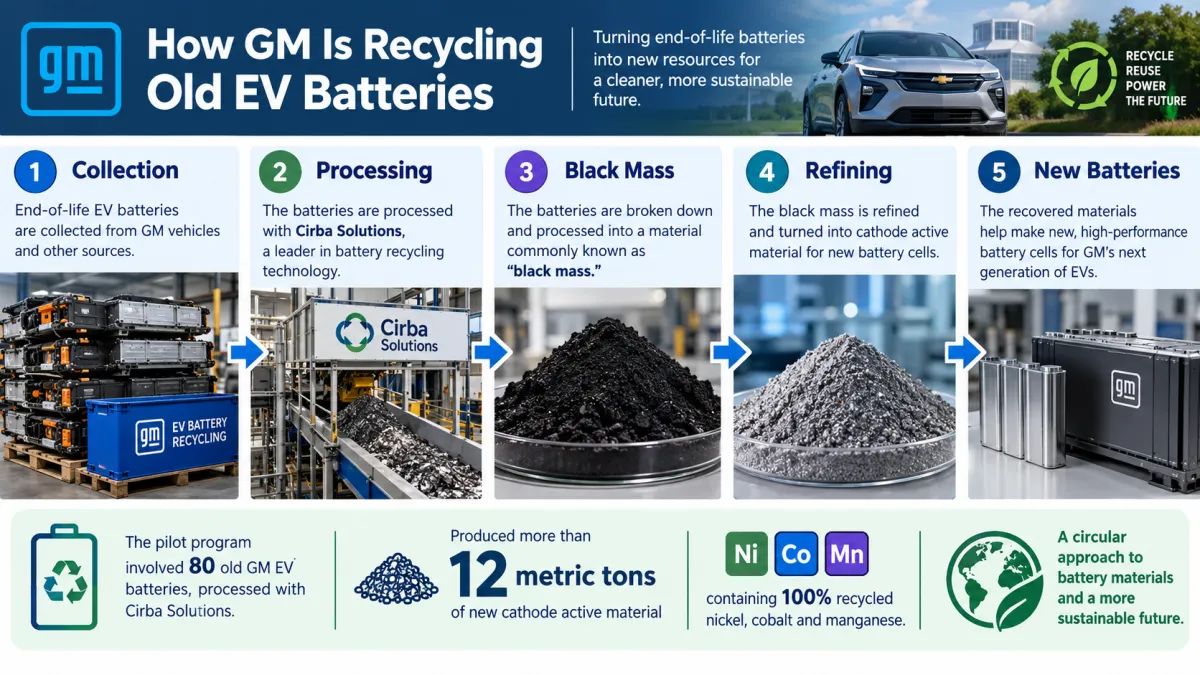
How GM Is Recycling Old EV Batteries
GM’s recycling program involves several stages. End-of-life EV batteries are collected and processed to recover useful materials. In the company’s recent pilot program, 80 old GM EV batteries were sent through a recycling process operated with Cirba Solutions.
The batteries were processed into a material commonly known as “black mass.” This contains valuable battery materials that can then be refined and turned into cathode active material for new battery cells.
GM says the pilot produced more than 12 metric tons of new cathode active material containing 100% recycled nickel, cobalt and manganese.
The Recycled Material Goes Back Into New EVs
The interesting part is that the recycled material did not simply remain in a recycling facility. GM used it in new battery cells.
Ultium Cells, the battery manufacturing joint venture involving GM and LG Energy Solution, produced battery cells using the recycled cathode material. Those cells were then assembled into battery modules and packs at GM manufacturing facilities.
GM uses the recycled materials to power several electric vehicles, including the Cadillac LYRIQ, LYRIQ-V, VISTIQ, ESCALADE IQ and IQL, as well as the Chevrolet Silverado EV Trail Boss and GMC Sierra EV AT4.
Will Recycled Batteries Perform Like New Ones?
This is one of the biggest questions for EV buyers.
GM says it tested the recycled materials to the same quality, performance and safety standards as new materials. The resulting cells met performance requirements before GM used them in vehicles.
That means the main change is where some of the battery materials come from—not that GM is using a lower-quality battery.
Why This Matters for Future EVs
Battery production requires significant quantities of minerals such as lithium, nickel, cobalt and manganese. Recycling these materials could give manufacturers another source of important battery ingredients while reducing the need to continually rely on newly extracted materials.
It could also become increasingly useful as the global number of retired EV batteries grows.
GM also explores ways to extend battery life. The company can refurbish or remanufacture some packs, while others can serve as stationary energy storage before GM recycles their materials.
A Bigger Shift in EV Battery Manufacturing
GM’s latest vehicles show that battery recycling is moving beyond a theoretical idea and into actual vehicle production.
The current program is still a pilot and does not mean every GM EV will immediately use recycled battery materials. However, it demonstrates how an old EV battery can potentially become part of the supply chain for a new electric vehicle.
As more EV batteries reach the end of their first useful life, technologies like this could become an increasingly important part of the industry’s future—turning yesterday’s batteries into materials for tomorrow’s electric cars.
Pingback: 5 Apple CarPlay Features Android Auto Still Doesn’t Have