Choosing between the iPhone 18 Pro and OnePlus 15 is not simply a choice between two powerful smartphones. The two companies take very different approaches to performance, cameras, software and everyday use. Apple has focused heavily on sustained performance and camera control with the iPhone 18 Pro, while OnePlus 15 combines flagship hardware with a high-refresh-rate display and a large battery.
Here is how the two phones compare in the areas that matter most.
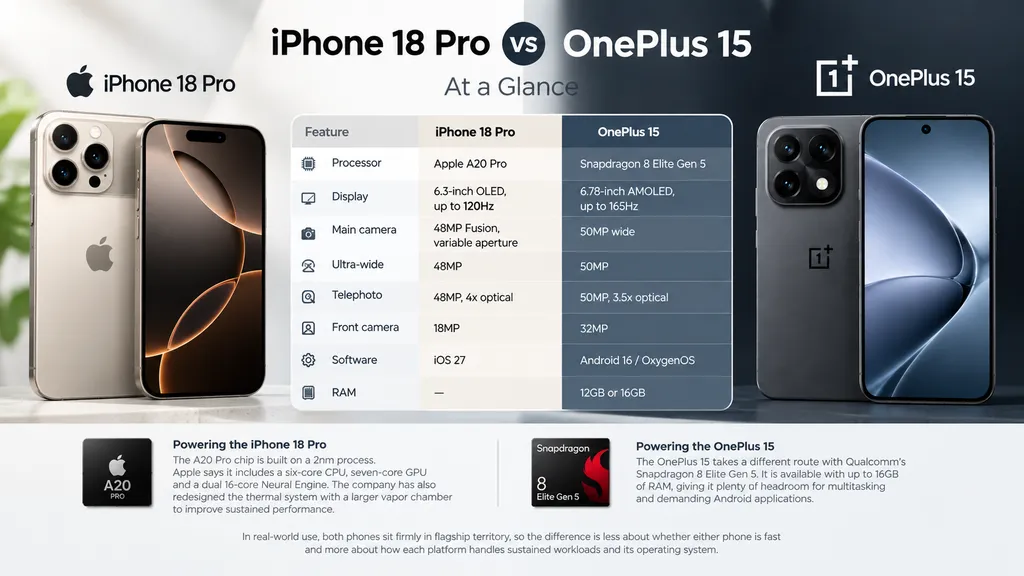
iPhone 18 Pro vs OnePlus 15: At a Glance
| Feature | iPhone 18 Pro | OnePlus 15 |
| Processor | Apple A20 Pro | Snapdragon 8 Elite Gen 5 |
| Display | 6.3-inch OLED, up to 120Hz | 6.78-inch AMOLED, up to 165Hz |
| Main camera | 48MP Fusion, variable aperture | 50MP wide |
| Ultra-wide | 48MP | 50MP |
| Telephoto | 48MP, 4x optical | 50MP, 3.5x optical |
| Front camera | 18MP | 32MP |
| Software | iOS 27 | Android 16 / OxygenOS |
| RAM | — | 12GB or 16GB |
Apple’s iPhone 18 Pro uses the new A20 Pro chip, built on a 2nm process. Apple says the chip includes a six-core CPU, seven-core GPU and a dual 16-core Neural Engine. The company has also redesigned the phone’s thermal system with a larger vapor chamber to improve sustained performance during demanding workloads.
The OnePlus 15 takes a different route with Qualcomm’s Snapdragon 8 Elite Gen 5. It is available with up to 16GB of RAM, giving it plenty of headroom for multitasking and demanding Android applications. In real-world use, both phones sit firmly in flagship territory, so the difference is less about whether either phone is fast and more about how each platform handles sustained workloads and its operating system.
For a closer look at Apple’s latest upgrades, read our iPhone 18 Pro vs iPhone 17 Pro: What’s New? comparison.
Camera: Apple Changes the Formula
The iPhone 18 Pro’s biggest camera change is its 48MP Fusion Main camera with a variable aperture. The aperture can automatically adjust depending on lighting and depth, while Apple also provides manual controls for photographers who want more control over their shots. The phone also has a 48MP ultra-wide and a 48MP telephoto camera with 4x optical zoom.
OnePlus 15 uses a three-camera setup built around 50MP sensors. Its telephoto camera provides 3.5x optical zoom, while the ultra-wide camera offers a 116-degree field of view. The hardware gives OnePlus a flexible setup for everyday photography, zoom shots and wider scenes.
The interesting difference is the photography philosophy. Apple is putting more emphasis on camera control and computational photography, while OnePlus continues to offer high-resolution hardware across all three rear cameras.
Which Is Better for Performance?
There is no simple answer based only on the processor names. The A20 Pro is designed around Apple’s tight integration between the chip, iOS and its thermal system, while the OnePlus 15 combines Snapdragon performance with Android and a high-memory configuration.
For long gaming sessions and demanding Android workloads, the OnePlus 15’s 165Hz display can also be useful where supported. The iPhone 18 Pro, meanwhile, uses a 120Hz ProMotion display and puts greater emphasis on sustained performance and efficiency.
The Bottom Line
The iPhone 18 Pro and OnePlus 15 are powerful flagships, but they are designed around different priorities. The iPhone 18 Pro brings Apple’s A20 Pro chip, variable-aperture camera and extensive camera controls. The OnePlus 15 counters with Snapdragon 8 Elite Gen 5 hardware, a 165Hz display, high RAM configurations and a versatile triple-camera system.
For someone comparing the two, the more useful question is not simply which phone has bigger numbers. It is whether you prefer Apple’s camera and software ecosystem or OnePlus’s Android flexibility and hardware-focused approach.